
Article
2026 Texas LTC Reciprocity Map: What You Need to Know Before Traveling
 By PHAM DEFENSE Editorial Team
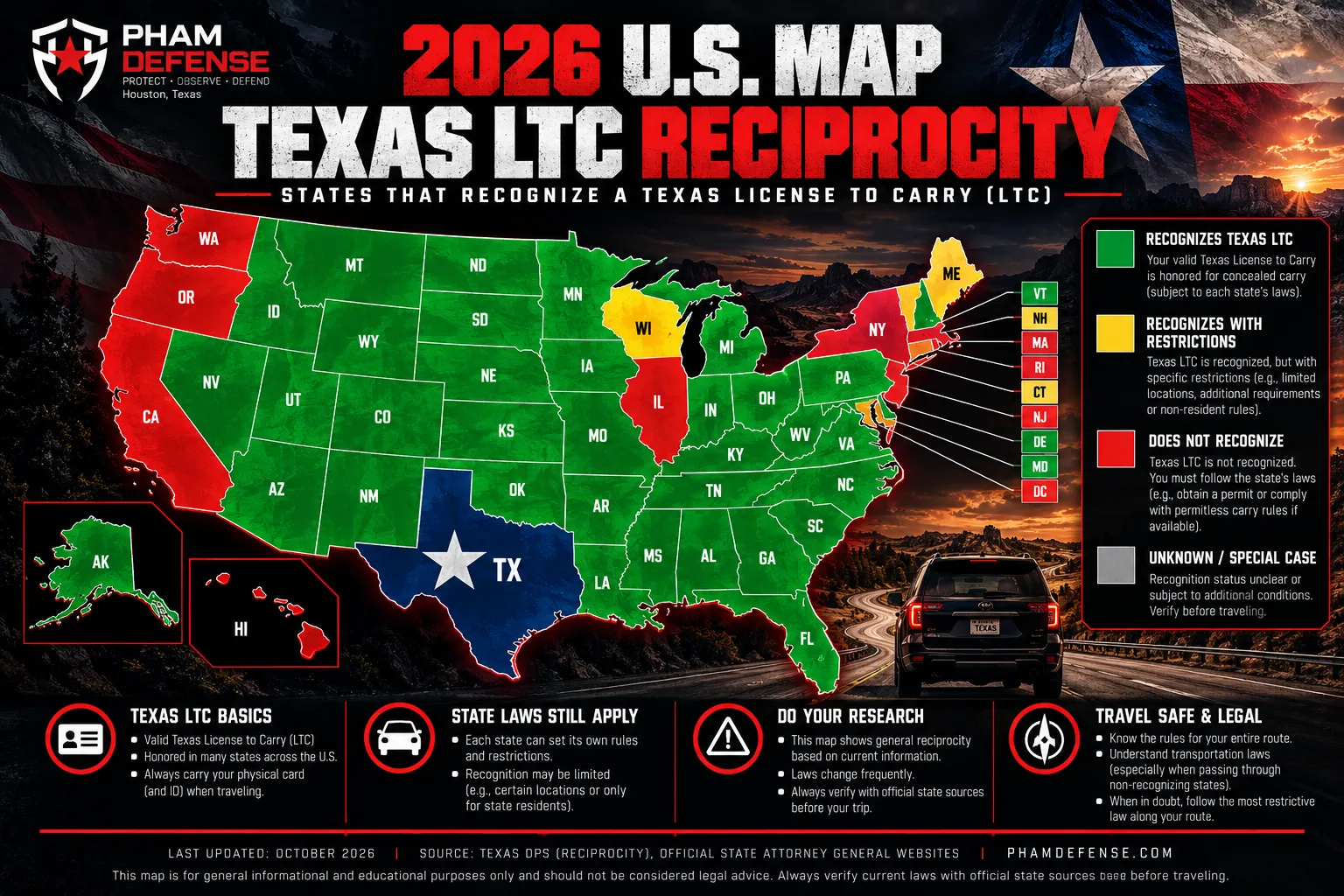
Your Texas License to Carry may be recognized in many states, but that doesn't mean you can carry your handgun everywhere.
Planning a road trip with your firearm? If you hold a valid Texas License to Carry (LTC), understanding interstate carry laws is essential.
Every state has its own firearm regulations. What's perfectly legal in Texas may be restricted or prohibited once you cross state lines.
1. Texas LTC Reciprocity: How Does It Work?
Reciprocity allows qualifying Texas LTC holders to legally carry handguns in other states that recognize their licenses.
However, states generally fall into three important categories:
Recognizes Texas LTC: Your valid Texas license is accepted, subject to that state's laws and restrictions.
Permitless Carry: Qualifying individuals may carry without a permit, even when Texas LTC recognition does not apply.
Does Not Recognize Texas LTC: Your Texas license alone does not authorize concealed carry. Another legal basis may still exist.
Some states impose additional conditions involving age, residency, or other requirements.
Remember: Your Texas LTC travels with you. Texas law doesn't.
2. Five Things Every Texas LTC Holder Should Check
1. License Recognition
Verify that your destination state recognizes your Texas LTC and that you meet its eligibility requirements.
2. Vehicle Carry Laws
Rules for loaded firearms, concealed carry inside vehicles, and firearm accessibility vary by state.
3. Restricted Locations
Even with a recognized license, firearms may be prohibited in certain government buildings, schools, businesses, and other designated locations.
4. Firearm and Magazine Restrictions
A recognized carry license does not automatically exempt you from state restrictions on firearms, magazine capacity, or ammunition.
5. Traffic Stops and Notification Requirements
Some states require armed individuals to notify law enforcement under certain circumstances. Know the rules before traveling.
3. What If You're Passing Through a Restrictive State?
Federal law, under 18 U.S.C. § 926A, provides limited protection for qualifying interstate firearm transportation.
Generally, the firearm must be unloaded, and the firearm and ammunition must not be readily accessible from the passenger compartment. Additional locked-container requirements apply to vehicles without a separate storage compartment.
Important: Federal transportation protection is not a nationwide concealed carry permit. Overnight stays, extended stops, and destination activities may create additional legal considerations.
4. Check Before You Travel
Before leaving Texas, review every state along your route—not just your final destination.
Use official sources to confirm current laws:
The Bottom Line
A Texas LTC is valuable, especially when traveling to states that recognize it. But reciprocity doesn't mean unlimited carry privileges.
Know your route. Know the laws. Carry responsibly.
PROTECT • OBSERVE • DEFEND
PHAM DEFENSE | phamdefense.com
Disclaimer: This article and accompanying map are for educational purposes only, not legal advice. Firearm laws and reciprocity agreements can change. Always verify current requirements with official state authorities before traveling.
Written by
PHAM DEFENSE Editorial TeamPHAM DEFENSE Editorial Team
The PHAM DEFENSE Editorial Team delivers informative, research-driven content on firearm safety, responsible gun ownership, self-defense, tactical gear, and firearms industry news. Our mission is to provide accurate, practical, and unbiased information that helps readers stay inf...
More from PHAM DEFENSE Editorial Team →